
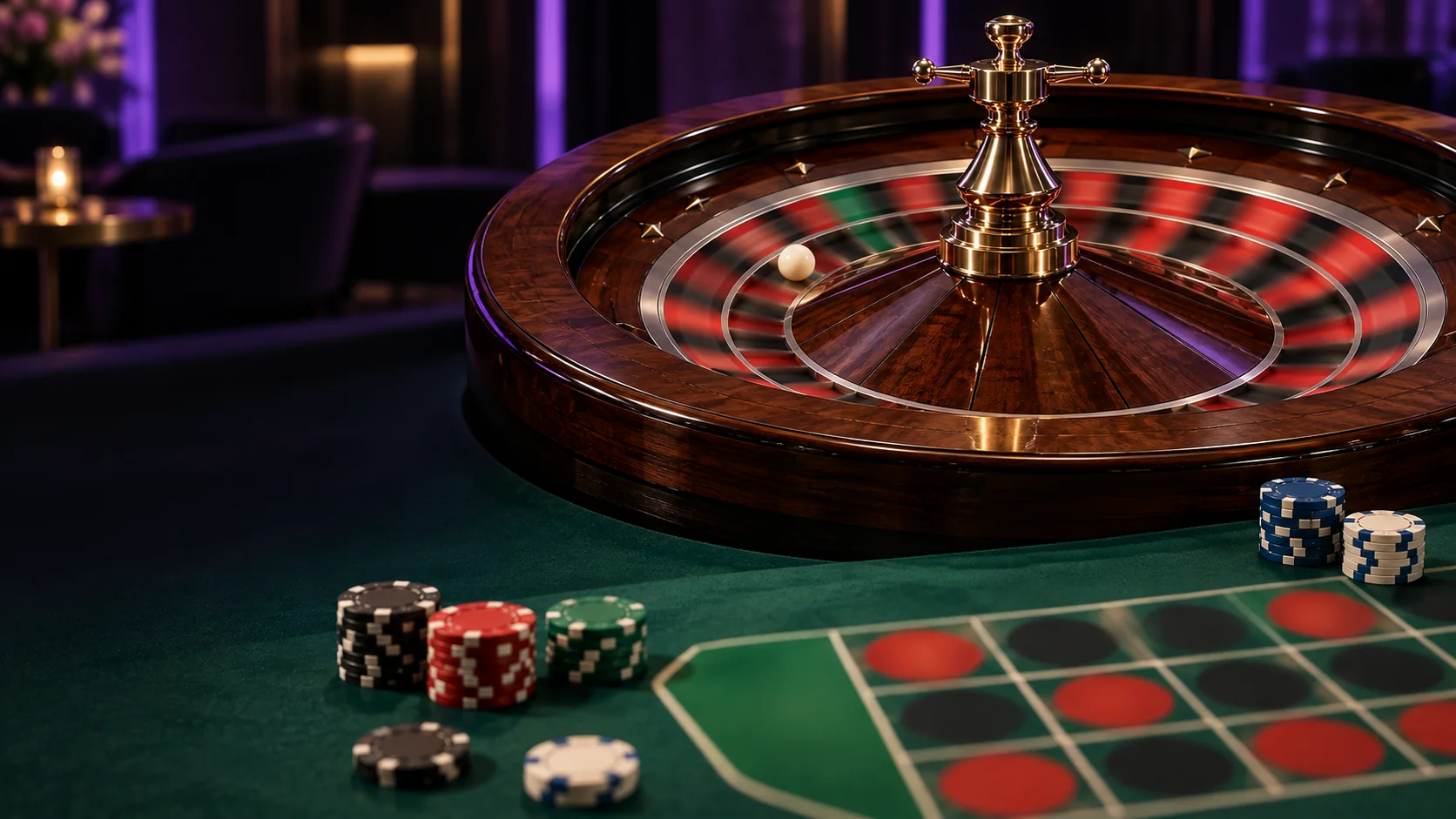
Identify the exact ACE66 wheel and accepted chip positions, then check number coverage, zero treatment, payout ratios and the final net result.
Roulette fundamentals
Start with the accepted wager
An ACE66 roulette bet wins only when the landing pocket belongs to the exact number or group recorded before betting closes.
A roulette round opens a betting window, accepts one or more positions, closes wagering, produces one valid landing pocket and settles every accepted position against that result. The ACE66 receipt or history entry is stronger evidence than a chip animation because it records the selection and amount that entered settlement.
Inside bets cover one number or a small adjoining group on the layout. Outside bets cover broader groups such as a dozen, column, colour, parity or range. The different ACE66 payout ratios reflect the number of covered pockets; a larger ratio does not make a result more predictable.
Every valid spin is a new random event. Earlier reds, blacks, highs, lows or individual numbers do not make another result due, and a hot-or-cold board cannot change the wheel. Use ACE66 history as a record of completed rounds rather than a forecasting tool.
Wheel and zero check
Confirm the pocket set before calculating
| Wheel or layout item | Single-zero reference | What to verify |
|---|---|---|
| Numbered pockets | 0 plus 1-36, for 37 pockets | Confirm whether the ACE66 wheel has one zero, 00 or another disclosed configuration. |
| Red and black | 18 red and 18 black | Zero is green and belongs to neither ACE66 colour group. |
| Odd and even | 18 odd and 18 even numbers | Zero is neither odd nor even on the standard ACE66 layout. |
| Low and high | 1-18 and 19-36 | Zero belongs to neither ACE66 range. |
| Dozens and columns | Three groups of 12 numbers | Match the ACE66 chip position to the intended group before the cutoff. |
Inside roulette bets
Compare number coverage and standard ratios
| Inside bet | Numbers covered | Standard profit payout | Layout check |
|---|---|---|---|
| Straight up | 1 | 35:1 | Inside one ACE66 number box. |
| Split | 2 | 17:1 | On the shared line between two adjoining numbers. |
| Street | 3 | 11:1 | At the outside edge of one ACE66 row of three. |
| Corner | 4 | 8:1 | At the point shared by four adjoining numbers. |
| Six line | 6 | 5:1 | At the ACE66 outer junction of two adjacent rows. |
Outside roulette bets
Read the group before relying on the price
| Outside bet | Numbers covered | Standard profit payout | Zero check |
|---|---|---|---|
| Dozen | 12 | 2:1 | Zero is outside every ACE66 dozen. |
| Column | 12 | 2:1 | Zero is outside the three regular columns. |
| Red or Black | 18 | 1:1 | Zero is outside both ACE66 colours. |
| Odd or Even | 18 | 1:1 | Zero is outside both parity groups. |
| Low or High | 18 | 1:1 | Zero is outside both ACE66 ranges. |
Payout formula
Separate profit from total return
For one winning position, multiply the accepted stake by the displayed profit ratio, then add the returned stake. A hypothetical RM10 straight-up win at 35:1 therefore creates RM350 profit plus RM10 returned stake, or RM360 total return. Apply this ACE66 formula only when the current paytable displays that ratio.
At 2:1, a winning RM10 position creates RM20 profit and RM30 total return. At 1:1, it creates RM10 profit and RM20 total return. An account entry should not label the total return as profit because part of that credit is the player's original stake.
A losing position returns RM0 unless a disclosed rule produces a refund or another treatment. A push or void can return a stake for a different reason and should not be described as a win. Use the ACE66 status and controlling rule to identify why money was returned.
Some tables disclose La Partage, En Prison or another special response when zero lands on qualifying even-money bets. Those rules are not universal and must not be inferred from the single-zero label alone. Apply special ACE66 zero handling only when the table expressly defines it.
RM50 payout examples
Calculate an RM50 position
| Illustrative winning position | Profit calculation | Total return and net result |
|---|---|---|
| RM50 straight up at 35:1 | RM50 × 35 = RM1,750 profit | ACE66 example: RM1,800 returned; RM1,750 net profit. |
| RM50 split at 17:1 | RM50 × 17 = RM850 profit | RM900 returned; RM850 net profit. |
| RM50 street at 11:1 | RM50 × 11 = RM550 profit | ACE66 example: RM600 returned; RM550 net profit. |
| RM50 corner at 8:1 | RM50 × 8 = RM400 profit | RM450 returned; RM400 net profit. |
| RM50 six line at 5:1 | RM50 × 5 = RM250 profit | ACE66 example: RM300 returned; RM250 net profit. |
RM100 payout examples
Calculate an RM100 position
| Illustrative winning position | Profit calculation | Total return and net result |
|---|---|---|
| RM100 dozen at 2:1 | RM100 × 2 = RM200 profit | ACE66 example: RM300 returned; RM200 net profit. |
| RM100 column at 2:1 | RM100 × 2 = RM200 profit | RM300 returned; RM200 net profit. |
| RM100 colour at 1:1 | RM100 × 1 = RM100 profit | ACE66 example: RM200 returned; RM100 net profit. |
| RM100 odd or even at 1:1 | RM100 × 1 = RM100 profit | RM200 returned; RM100 net profit. |
| RM100 low or high at 1:1 | RM100 × 1 = RM100 profit | ACE66 example: RM200 returned; RM100 net profit. |
Overlapping roulette bets
Calculate every chip position separately
Several accepted positions can cover the same winning number. A straight, split, street, corner or outside group can therefore win on one spin while other positions lose. Reconstruct the ACE66 result by calculating each receipt entry, then add every return and subtract the full amount staked.
An RM50 total spread across five RM10 positions is not one RM50 straight-up wager. Each RM10 selection has its own coverage and ratio, and only positions containing the landing number qualify. The ACE66 history should show the separate accepted amounts needed for that calculation.
Neighbour, racetrack and zero-area controls may create several chip positions through one interface action. Names such as trio, basket or neighbours do not define identical coverage on every variant. Inspect the complete ACE66 covered-number list and total stake before confirming.
Auto-bet, repeat and favourite controls can copy an earlier layout or amount. After changing a table, wheel type or stake, match every ACE66 position to the intended coverage. Stop rather than repeatedly clicking when the accepted record cannot be verified.
Roulette settlement checklist
Audit a roulette payout in a fixed order
Identify the exact table
Record the ACE66 table or game name, provider shown, wheel type, rule version and currency without exposing account secrets.
Copy the controlling paytable
Note the ACE66 ratio, covered-number definition, zero rule, limits and any void condition displayed for the round.
Confirm the accepted layout
Use the ACE66 receipt to list every position and stake; an unsubmitted chip or incomplete animation is not an accepted transaction.
Match the completed pocket
Use the final ACE66 round identifier and landing number rather than an incomplete stream frame or third-party result.
Separate each amount
Calculate ACE66 profit, returned stake, losing positions and total return separately before finding the net result.
Check special handling
Look for a disclosed ACE66 zero, correction, interrupted-spin, re-spin or void rule rather than assuming one universal procedure.
Escalate only the remaining difference
Share the minimum non-sensitive ACE66 evidence through a verified support route; never reveal a password, PIN, OTP or full payment credential.
Responsible-play boundary
Rules do not predict the next spin
Roulette FAQ
Answer common bets and payouts questions
Does a straight-up 35:1 payout include the stake?
No. The standard 35:1 figure describes profit. A winning one-unit position ordinarily returns 35 units of profit plus the original unit, subject to the ACE66 paytable.
Is zero red, black, odd or even?
No. On the standard layout, zero is green and belongs to none of those groups. Check the ACE66 rules for any expressly disclosed special treatment of qualifying even-money bets.
Are European and American roulette the same?
No. European roulette normally has one zero, while American roulette normally adds 00. Confirm the ACE66 wheel type before using a payout, probability or coverage example.
Does a larger payout mean a better chance of winning?
No. Standard larger ratios correspond to fewer covered pockets. An ACE66 ratio explains payment after a win; it does not predict the landing pocket.
Can earlier spins predict the next result?
No. Spins are independent. ACE66 history can document completed results but cannot make a number, colour, dozen or column due.
What should be checked when a payout looks wrong?
Match the ACE66 table, wheel type, round ID, accepted positions, stakes, landing pocket, paytable and special rules, then ask verified support about the specific remaining difference.