
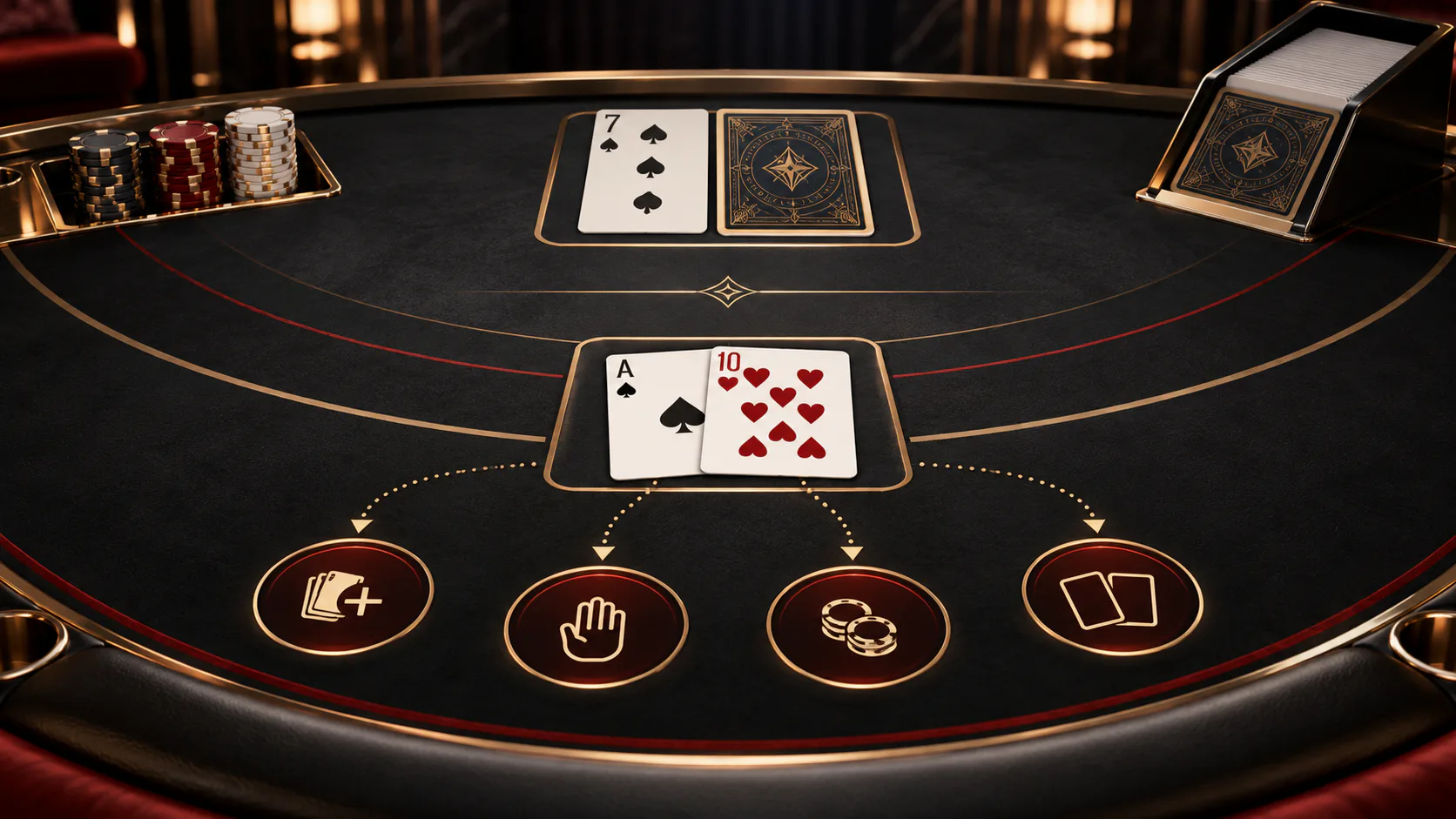
Check the exact ACE66 blackjack table rules, available actions and card sequence, then calculate the payout for a natural, ordinary win, push, surrender or insurance result.
Blackjack fundamentals
Record the table rules before reading the hand
Record the table version and payout rules first, then compare the player's completed hand with the dealer's completed hand without losing track of table-specific conditions.
Before reading the cards, record the exact ACE66 game version, natural-blackjack payout, S17 or H17 rule, and whether Double, Split, Insurance and Surrender are available. These details determine how the same cards and actions can be classified and settled.
A player does not compete against the other seats at the table. Each active hand is compared with the dealer after both sides finish under the applicable procedure. An ACE66 hand that exceeds 21 busts and normally loses immediately, even if the dealer later also exceeds 21.
A total below 21 is not automatically a winner. If neither side busts, the higher valid total wins; equal qualifying totals commonly push and return the main stake. Confirm that settlement wording in the ACE66 table rules because special variants and side wagers can follow separate conditions.
Rules knowledge explains choices and results, but it cannot reveal the next card or remove randomness. Use the ACE66 guide as a reading framework, choose only a discretionary amount that can be lost and avoid changing a decision because of earlier wins or losses.
Card values
Read every hand consistently
| Card or hand | Usual value | What to check |
|---|---|---|
| Cards 2-10 | Face value | Add the printed values to the hand total. |
| J, Q and K | 10 | Every ten-value card contributes 10 in an ACE66 total. |
| Ace | 1 or 11 | Use 11 unless that would bust the hand; otherwise count it as 1. |
| Soft and hard hands | Depends on the Ace | An ACE66 soft total contains an Ace still counted as 11; a hard total does not. |
Blackjack round flow
Follow a round in order
Read the table panel
Check the blackjack payout, dealer Soft 17 rule, Double and Split limits, surrender availability and any special conditions shown for the ACE66 table.
Confirm the accepted main wager
Use the accepted amount and table name as the baseline; an unsubmitted chip placement is not an ACE66 transaction.
Read the initial deal
Identify both player cards and the dealer upcard, then distinguish a two-card blackjack from another total of 21.
Choose only an available action
Hit, Stand, Double, Split, Insurance or Surrender appears only when the game and current ACE66 hand permit it.
Let the dealer complete and settle
After player actions end, the dealer follows the stated rule and the system compares each active hand separately.
Player actions
Know Hit, Stand, Double and Split
Hit requests another card for the current hand. The new card changes the total, and the hand can continue if the interface permits or end immediately by busting. An ACE66 Hit is a rule-defined action, not evidence that another card will improve the result.
Stand ends the player's drawing decisions for that hand and leaves its current total to be compared after the dealer finishes. An ACE66 player can use Stand only as a decision on the present hand; it does not lock in a win or prevent the dealer from reaching a higher valid total.
Double usually adds an additional wager and gives exactly one further card before the hand stands, but eligible starting totals and Double-after-Split rules vary. Read the ACE66 control and displayed conditions before treating a Double example as available.
Split turns an eligible pair into two hands and normally requires a second stake equal to the original main wager. Each ACE66 split hand then receives cards and settles separately, subject to limits on resplitting, split Aces, drawing and doubling.
Dealer rules
Check Soft 17 and the dealer procedure
The dealer does not choose freely between Hit and Stand. The table follows a fixed procedure, commonly drawing through 16 and then either standing on all 17s or hitting a Soft 17. The ACE66 table panel should state whether the dealer stands on Soft 17 (S17) or hits Soft 17 (H17).
A Soft 17 contains an Ace counted as 11, such as Ace plus 6. If the dealer must Hit Soft 17, another card is drawn; if the dealer must Stand, the hand stops. That single ACE66 rule can change how the same visible cards proceed, so never infer it from another table.
Dealer peek, hole-card timing and no-hole-card procedures can also affect when blackjack is checked and how additional Double or Split stakes are handled. Use the current ACE66 procedure rather than importing assumptions from a land-based table, another provider or an older screenshot.
Blackjack versus 21
Separate a natural blackjack from other 21s
A natural blackjack is normally the first two cards: one Ace plus one ten-value card. It can carry a special payout and may outrank a dealer total of 21 made with more cards. Confirm the ACE66 table wording because the displayed payout and comparison rule govern the real hand.
A total of 21 created with three or more cards is usually an ordinary 21, not a natural blackjack. The same distinction can apply when a ten-value card follows a split Ace. Do not assign a blackjack payout to an ACE66 hand merely because its final arithmetic total is 21.
When both the player and dealer have a qualifying blackjack, the main wager commonly pushes, but a variant can define special handling. Review the ACE66 result label, initial card count and payout shown in the rules before deciding that a credit is missing.
Double and Split checks
Compare additional-stake conditions
| Feature | Question to answer | Why it matters |
|---|---|---|
| Double | Which starting totals qualify? | ACE66 may limit Double to specified totals or initial two-card hands. |
| Double after Split | Is DAS permitted? | ACE66 split hands may use different action limits from an unsplit hand. |
| Resplitting | How many hands can be created? | The ACE66 table limit controls whether another matching card may be split again. |
| Split Aces | Can more cards be drawn or Aces resplit? | ACE66 can restrict split-Ace draws and classify Ace-plus-ten as ordinary 21. |
Optional rules
Treat Insurance, Even Money and Surrender separately
Insurance is a separate wager that may be offered when the dealer shows an Ace. A common example permits up to half the main stake and pays 2:1 if the dealer has blackjack, while the main hand settles independently. Read the ACE66 amount, payout and eligibility instead of describing insurance as protection from every loss.
With an RM50 main wager, an illustrative RM25 insurance wager that wins at 2:1 returns RM75 in total: RM50 profit plus the RM25 insurance stake. The RM50 main hand still has its own ACE66 result, so combine both entries before calculating the round's net outcome.
Even Money can be an optional 1:1 settlement when the player has blackjack and the dealer shows an Ace. Its availability and mechanics depend on the rules. Do not assume an ACE66 interface offers Even Money or that accepting it produces the best result in every circumstance.
Surrender can end an eligible hand before normal completion and commonly returns half the main stake while forfeiting the other half. Timing and eligibility vary, including early and late forms. Use the ACE66 Surrender control and rules; closing a table or choosing Stand is not the same action.
RM settlement examples
Compare total return with net result
| Illustrative case | Calculation | Total return and net result |
|---|---|---|
| RM50 ordinary win at 1:1 | RM50 profit + RM50 returned stake | ACE66 example: RM100 total return; RM50 net profit. |
| RM50 blackjack at 3:2 or 6:5 | 3:2 gives RM75 profit; 6:5 gives RM60 profit | ACE66 example: RM125 or RM110 total return, depending on the displayed rule. |
| RM50 Double with another RM50 | RM100 total stake; a 1:1 win returns RM200 | ACE66 example: RM100 net profit if the doubled hand wins. |
| RM50 split into two RM50 hands | One 1:1 win returns RM100; one loss returns RM0 | ACE66 example: RM100 total return on RM100 staked, so the combined net result is RM0. |
Blackjack settlement checklist
Audit a result in a fixed order
Identify the exact table
Record the ACE66 table or game name, provider, rule version and time without exposing account secrets.
Copy the controlling rules
Note the ACE66 blackjack payout, S17 or H17 procedure, Double, Split, surrender and insurance terms displayed for that session.
Reconstruct the cards
List the initial cards, every Hit and the dealer sequence so ACE66 can distinguish a natural blackjack, ordinary 21, bust or push.
Separate every stake
Track the main wager, Double amount, each split hand and any insurance as distinct ACE66 entries before adding the net result.
Escalate only the remaining discrepancy
Share the bet ID and minimum necessary evidence through a verified support route; never reveal a password, PIN, OTP or full payment credential.
Responsible-play boundary
Rules do not predict the next hand
Blackjack FAQ
Answer common blackjack rules questions
Is a two-card blackjack different from a three-card 21?
Yes. A natural blackjack is normally Ace plus a ten-value card as the first two cards, while a three-card 21 is usually an ordinary 21. The table rules control comparison and payout.
Does the dealer always Stand on Soft 17?
No. Some tables use S17 and others use H17. Read the dealer rule displayed for the current table before the round.
Is a 3:2 blackjack payout guaranteed?
No. 3:2 and 6:5 are both possible examples, and variants may use another disclosed condition. The ACE66 table panel must be checked before play.
Can a player Double after Split or split Aces again?
Only when that table allows it. Double-after-Split, resplitting and split-Ace draws are separate rule settings.
What should be checked when a settlement looks wrong?
Match the table version, accepted stakes, initial cards, actions, dealer sequence, special payout and optional wagers, then ask verified support about the specific remaining difference.